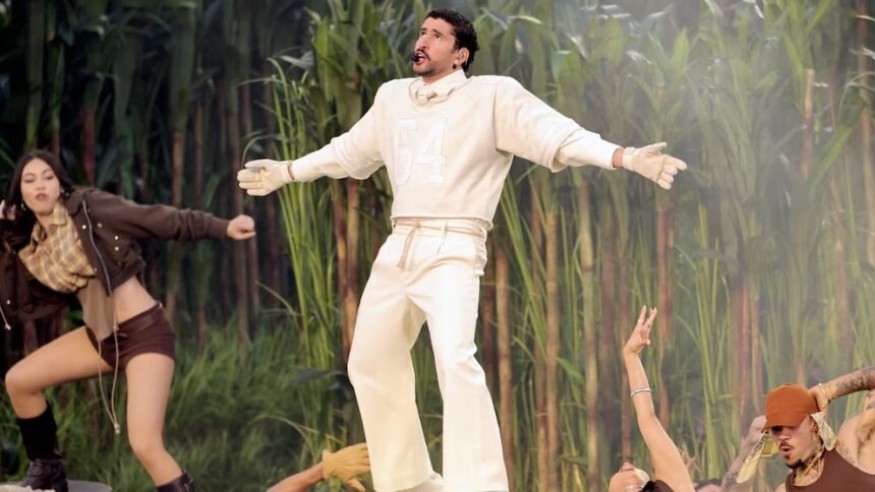
Bad Bunny is redefining the global reach of Latin music as “DtMF” sets a new historic record on the charts. The track surpasses one of the most iconic milestones of the streaming era, placing Bad Bunny at the center of a shift that continues to expand Latin music worldwide.
Bad Bunny is once again shifting the conversation around Latin music, as “DtMF” reaches a milestone that places it among the most impactful songs in chart history. The track’s performance is not just another success story. It represents a turning point in how Latin music is positioned globally, with Bad Bunny leading a movement that continues to grow beyond traditional boundaries.
The achievement of “DtMF” staying at No.1 on the Hot Latin Songs chart for 57 weeks stands out as one of the most significant records in recent years. For decades, this chart has been a key measure of influence within the Latin music space. Bad Bunny now occupies a position that reflects both consistency and deep audience connection, showing how sustained engagement can define a song’s legacy.
Before this, the benchmark was held by “Despacito,” a track that helped bring Latin pop into the global mainstream. The comparison between the two songs goes beyond numbers. “Despacito” opened the door for wider recognition, while “DtMF” demonstrates how that recognition has evolved into long-term presence. Bad Bunny is not introducing something new to the world. He is building on a foundation that has already expanded.
The success of “DtMF” aligns closely with Bad Bunny’s broader trajectory. Over the past few years, he has established a consistent presence that extends beyond individual hits. His catalog functions as a unified body of work, where each release contributes to a larger identity. “DtMF” fits naturally into this pattern, reinforcing his position within the global music landscape.
At the same time, the track’s reach extends far beyond Latin charts. Its performance across multiple regions highlights how Bad Bunny connects with audiences from different cultural backgrounds. “DtMF” is not confined to a specific market. It moves across borders, reflecting how listening habits have changed in the streaming era.
One of the most defining elements of this success is the continued use of Spanish. Bad Bunny does not shift his language to fit global expectations. Instead, he maintains his artistic identity, showing that international success can be achieved without compromise. “DtMF” becomes a clear example of how authenticity can drive widespread appeal.
The role of streaming platforms is central to this development. Digital access allows songs to travel faster and reach broader audiences than ever before. Bad Bunny is operating within this environment with precision, using visibility and engagement to sustain momentum. “DtMF” benefits from this structure, maintaining relevance over an extended period.
Latin music itself is in a phase of expansion, where its influence continues to grow across different markets. “DtMF” is part of that movement, acting as both a result and a driver of this shift. Bad Bunny represents a generation of artists who are redefining what global success looks like, moving beyond traditional industry pathways.
Breaking the record previously held by “Despacito” also carries symbolic meaning. It marks a transition between two defining moments in Latin music. Where one track introduced global audiences to the genre, the other confirms that its place is now firmly established. Bad Bunny stands at the center of this transition, shaping what comes next.
The impact of “DtMF” is not limited to charts. It also influences how other artists approach their work. The idea that a Spanish-language track can dominate for such an extended period opens new possibilities. Bad Bunny’s success becomes a reference point for future releases within the genre.
Another key factor is how the song continues to evolve in terms of audience interaction. Playlists, social media, and repeated listening all contribute to its ongoing performance. “DtMF” is not driven by a single moment of popularity. It maintains its presence through continuous engagement, which defines its long-term success.
At the same time, Bad Bunny’s broader visibility plays a role in sustaining interest. His public presence, combined with consistent releases, keeps attention focused on his work. “DtMF” benefits from this environment, remaining part of a larger narrative that continues to develop.
The current landscape of music consumption allows older and newer releases to exist together. In this context, “DtMF” stands out as a track that bridges different phases of listening behavior. Bad Bunny is able to maintain relevance by adapting to these shifts without losing his core identity.
As the song continues its run, its influence is likely to extend further. “DtMF” is not just setting records. It is contributing to a broader redefinition of how success is measured in music. Bad Bunny remains a central figure in this process, shaping the direction of Latin music on a global scale.
The overall picture that emerges is one of steady transformation. Latin music is no longer confined to a specific category within the industry. Through tracks like “DtMF,” it becomes part of a global mainstream, with Bad Bunny playing a leading role in that transition.