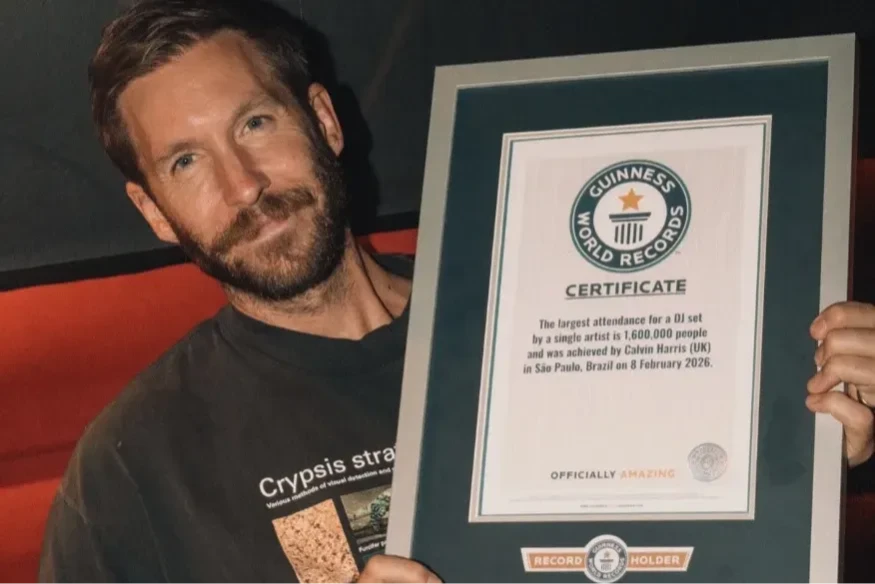
Calvin Harris has officially entered the Guinness World Records after his massive São Paulo performance drew an estimated 1.6 million people. The February 8, 2026 DJ set at Bloco Skol was recognized as the largest attendance for a DJ set by a single artist. Staged on Rua da Consolação during the city’s pre-Carnival celebrations, the free event became one of the year’s biggest live music moments in Brazil.
Calvin Harris has turned one of the biggest nights of his career into an official Guinness World Record. His February 8 performance in São Paulo has now been recognized as the largest attendance for a DJ set by a single artist, with an estimated 1.6 million people filling the streets around Rua da Consolação.
The scale of the event was already striking when it happened. Harris performed as part of Bloco Skol, a free pre-Carnival street celebration in central São Paulo, playing from a moving carnival truck rather than a conventional stage. The setting gave the performance the feel of a giant open-air festival woven directly into the city.
Seven months later, the number attached to that day has been formally certified.
The Guinness category is important to define clearly. Harris does not hold a general record for the largest concert audience of all time or the biggest electronic music event ever staged. The recognition applies specifically to attendance at a DJ set by one solo artist, with the 1.6 million figure used as the official estimate.
Because Bloco Skol was a free street event, there was no ticket count to provide an exact attendance figure. The total reflects the estimated number of people gathered along the route and in the surrounding area. That makes it different from a stadium or arena show, where attendance can be verified through ticket scans.
The images from São Paulo made that distinction easy to understand. Large sections of Rua da Consolação disappeared beneath the crowd, while aerial footage showed people stretching far beyond the immediate area around Harris’ truck. The event looked less like a single contained concert and more like a city block transformed by sound.
Harris embraced the setting. He appeared wearing a Brazil national team shirt with “Calvinho” and the number 00 on the back, a playful detail that quickly became one of the most recognizable images from the day.
His set leaned heavily on the songs that have defined his crossover between dance music and global pop. Tracks including “This Is What You Came For,” “One Kiss,” “I Need Your Love” and “We Found Love” gave the crowd a run of familiar moments built for a setting of that size.
The song choices made sense for an event that was never designed around a niche club audience. Harris has spent much of his career making records that travel easily between festivals, radio, streaming platforms and mainstream pop, and the São Paulo set drew directly from that catalog.
The crowd size also created challenges. Reports from the day described heavy congestion in sections of Rua da Consolação, with authorities using crowd-control measures and limiting access in certain areas. Some attendees were also reported to have felt unwell in the density of the gathering.
Those details do not change the reason the event has returned to the headlines now. The new development is the Guinness certification itself, which gives formal recognition to a figure that had already been associated with the performance since February.
Harris shared the news publicly after receiving the record, looking back on the night as something extraordinary even by the standards of his career. He described the experience as surreal and emphasized how uniquely Brazilian the entire situation felt.
That reaction makes sense given the format. This was not a Las Vegas residency, a festival headline slot or a stadium show. It was a Carnival-style street event in one of the world’s largest cities, with Harris performing above a moving mass of people rather than in front of a fixed seated audience.
The distinction also matters when comparing the event with other giant crowds in Brazil. The country has hosted free concerts with enormous attendance figures before, sometimes exceeding the total associated with Harris. But those events do not necessarily fall into the same Guinness category.
The record belongs specifically to a solo DJ set.
That narrower definition is what gives the achievement its precision. Guinness World Records judge Will Munford highlighted the scale of the performance and the reach of Harris’ music, while the official wording continues to use the phrase “estimated attendance” when referring to the 1.6 million people.
That is the most accurate way to describe it.
The crowd was not counted through ticketing. It was estimated through the nature and size of a public street event, so presenting the figure as exact would suggest a level of certainty the format simply cannot provide.
Bloco Skol itself also involved more than one artist. Brazilian performers were part of the wider program, and the event functioned as a large Carnival block rather than a standalone Calvin Harris concert. The Guinness recognition therefore relates to his individual DJ set within that broader event, not to the idea that he was the only performer involved in the day.
That context does not reduce the achievement. If anything, it helps explain why the performance became possible in the first place. Brazil’s Carnival culture is built around mass public participation, outdoor music and city-scale movement, creating conditions unlike those of a traditional concert market.
Harris arrived with a catalog already designed for mass recognition. His biggest records have spent years moving between clubs, festivals and pop charts, and the São Paulo crowd represented a physical version of that global reach.
For an artist whose career is often measured through streaming totals, chart positions and festival bookings, the record offers a very different metric. This time, the number came from bodies in the street rather than digital plays or ticket revenue.
The certification also arrives while Harris remains active internationally. It is not being framed as a career retrospective or a final milestone. Instead, it becomes another major distinction added during an ongoing touring and release cycle.
That matters because Guinness records can sometimes be treated as novelty achievements detached from an artist’s wider career. In this case, the scale of the São Paulo performance fits naturally into the way Harris has operated for years: large-format dance music built for enormous audiences.
The live itself also showed how effectively his biggest songs can function outside their original contexts. Tracks recorded with Rihanna, Dua Lipa and Ellie Goulding became part of a Brazilian Carnival environment, surrounded by local culture and a crowd format very different from the clubs and festivals where they first became familiar.
That adaptability is part of what made the night memorable.
There is also something unusual about the fact that the most important number attached to the show came months after the music stopped. On February 8, the story was the spectacle: the crowd, the moving truck, the shirt, the chaos and the scale. In September, the same day has acquired a more formal identity.
It is now a world record.
For Harris, the certificate gives an official label to an image that already felt oversized when it first circulated. For the audience, it turns a free pre-Carnival gathering into a documented piece of live music history.
Whether the 1.6 million figure will remain unbeaten is impossible to know. Street events can produce extraordinary crowds, and another DJ may eventually find the right combination of city, access and cultural moment to challenge it.
For now, the benchmark belongs to Calvin Harris. His February 8 set in São Paulo stands as the largest attendance officially recognized by Guinness World Records for a DJ performance by a single artist.